Author: M Abo Bakar Aslam
Logic Gates
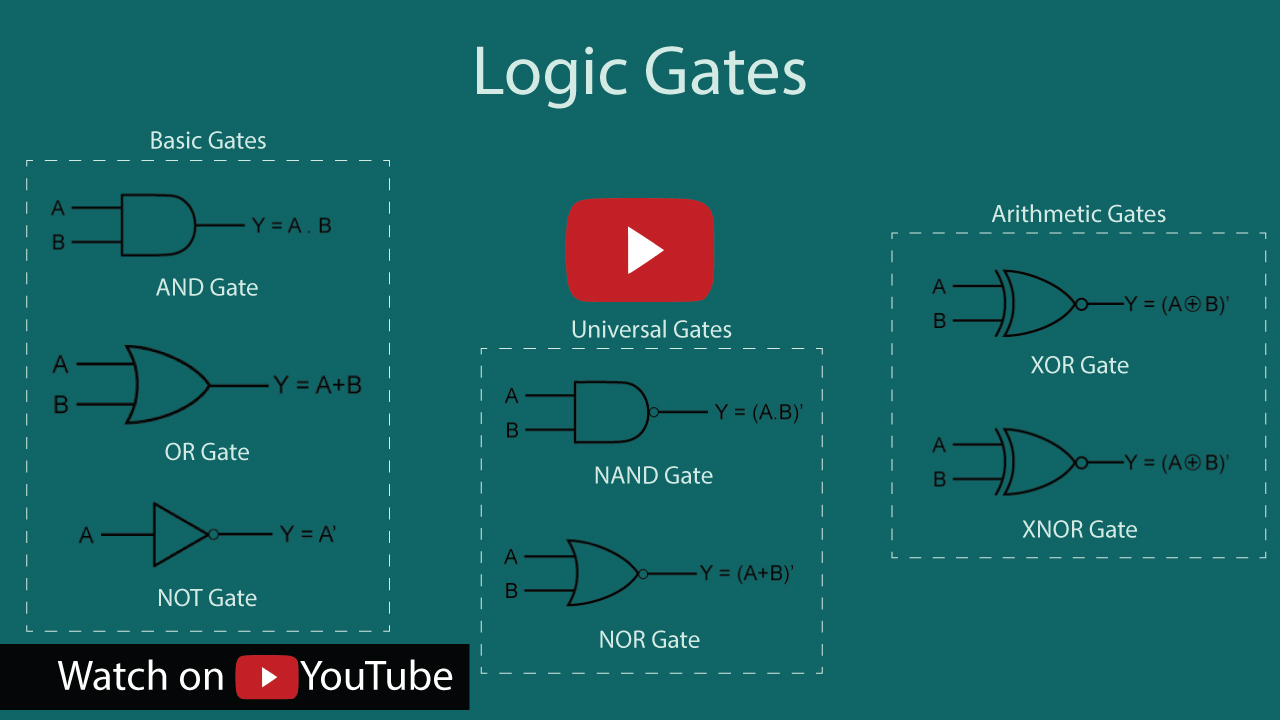
In digital logic design, there are some logic gates where we applied some inputs and they generate output according to provided inputs. Output of these logic gates depends upon current inputs. In other words, output will be changed if we change the input.
 07:51
07:511. Types of Logic Gates
There are following seven logic gates.
- AND Gate
- OR Gate
- NOT Gate
- NAND Gate
- NOR Gate
- XOR Gate
- XNOR Gate
2. Basic Logic Gates
There are following basic logic gates (first three). These are so called basic-logic-gates because we can construct rest of the gates using these basic gates.
- AND Gate
- OR Gate
- NOT Gate
3. AND Gate
The AND gate will generate outputs as HIGH only when all inputs are HIGH. It performs logical multiplication in digital electronics. See more detail

4. OR Gate
The OR gate produces a HIGH output when any input is HIGH. It performs logical addition in combinational logic circuits. See more detail

5. NOT Gate
Input is just inverted to generate output. The NOT gate, also called an inverter It output will be opposite to its input. It converts HIGH to LOW and LOW to HIGH. See more detail

6. NAND Gate
The NAND gate is the inverse of the AND gate and outputs LOW only when all inputs are HIGH. See more detail

7. NOR Gate
The NOR gate is the inverse of the OR gate and produces HIGH only when all inputs are LOW. See more detail

8. XOR Gate
Output will be 1, if number of 1's in inputs are ODD. This is also called ODD Function. See more detail

9. XNOR Gate
Output of XOR gate is just inverted. See more detail

10. Universal Gates
Following two logic gates are also called universal gates.
- NAND Gate
- NOR Gate
11. Arithmetic Gates
Following two logic gates are also called arithmetic gates.
- XOR Gate
- XNOR Gate