Author: M Abo Bakar Aslam
Karnaugh Map - 4 Variables
A Karnaugh Map (K-Map) is a visual method used to simplify Boolean expressions in combinational logic circuits. It reduces complex logic functions into minimal forms, helping designers create efficient digital circuits.
Structure of 3-Variable Karnaugh Map
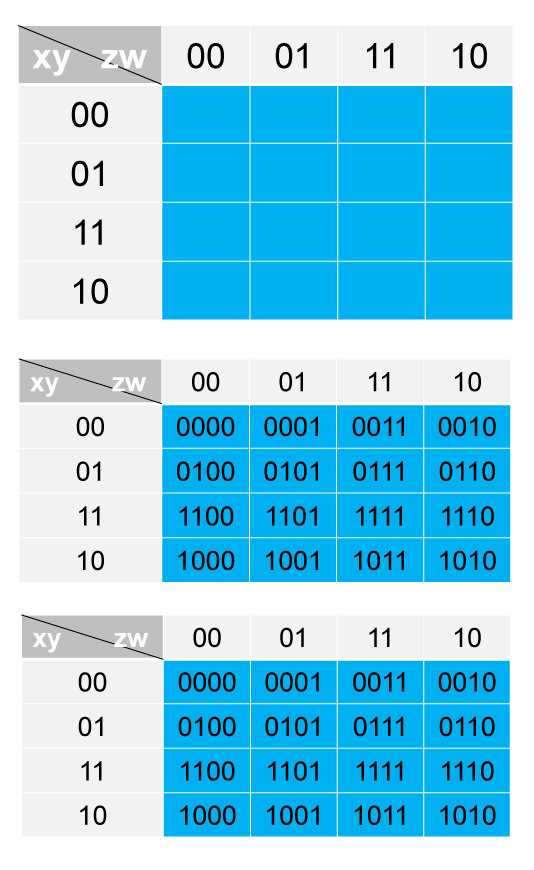
A 4-variable K-Map consists of 16 cells, representing all possible combinations of inputs x, y, z and w. Each cell corresponds to a minterm of the Boolean function. The map is arranged in Gray code order so that only one variable changes between adjacent cells, enabling easy grouping and simplification of logic terms.
- Number of Input Variables = n = 4
- Total Number of Cells in K-map = 2^n = 2^4 = 16
Rules for Construction of K-Map and Grouping
- Allowed number of 1's in a group are 1, 2, 4, 8, 16. These number of power of 2 i.e., 2^0(1), 2^1(2), 2^2(4), 2^3(8), 2^4(16) 2. Increase number of 1's in a group
- Decrease number of groups
- Only adjacent-cells can be in a group. Diagonal cells are not allowed to be in a group.
1. Example - 1
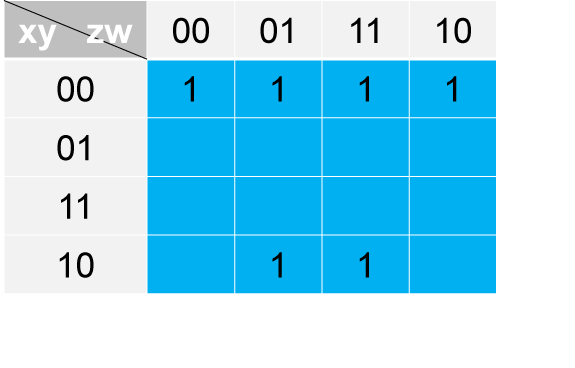
Reduce F = x’y’z’w’ + x’y’z’w + x’y’zw + x’y’zw’ + xy’z’w + xy’zw to minimum number of literals
Step 1:
Placing 1 for respective box according to above structure.
Step 2:
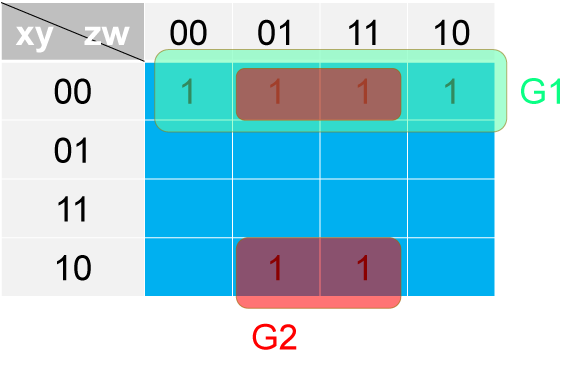
Make groups of join-boxes containing values
Step 3:
For each group, select variable whose is not changed. And then create respective literal
For G1: x=0, y=0 → x’, y’
For G2: y=0, w=1 → y’, w
Step 4:
Create minterm for each group
For G1: x’y’
For G2: y’w
Step 5:
Create final function by adding for all minterms
F = x’y’ + y’w
2. Example - 2
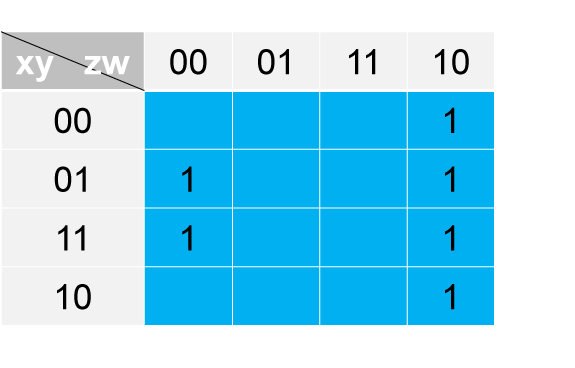
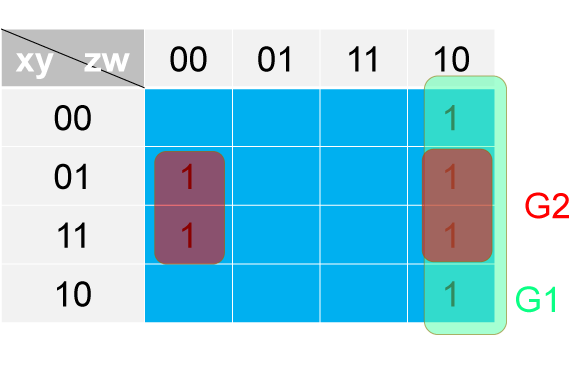
Reduce F = x’yz’w’ + xyz’w’ + x’y’zw’ + x’yzw’ + xyzw’ + xy’zw’ to minimum number of literals
Step 1:
Placing 1 for respective box according to above structure.
Step 2:
Make groups of join-boxes containing values
Step 3:
For each group, select variable whose is not changed. And then create respective literal
For G1: z=1, w=0 → z, w’
For G2: y=1, w=0 → y, w’
Step 4:
Create minterm for each group
For G1: zw’
For G2: yw’
Step 5:
Create final function by adding for all minterms
F = zw’ + yw’
3. Example - 3
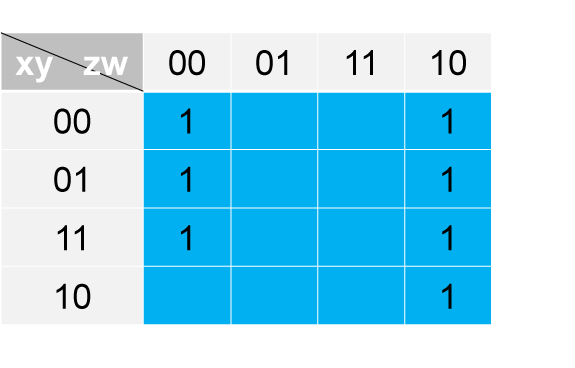
Reduce F = x’yz’w’ + xyz’w’ + x’y’zw’ + x’yzw’ + xyzw’ + xy’zw’ + x’y’z’w’ to minimum number of literals
Step 1:
Placing 1 for respective box according to above structure.
Step 2:
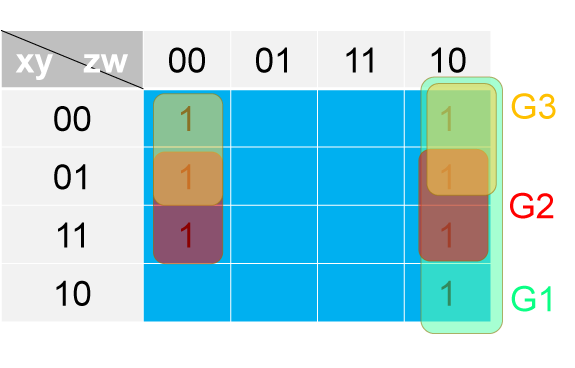
Make groups of join-boxes containing values
Step 3:
For each group, select variable whose is not changed. And then create respective literal
For G1: z=1, w=0 → z, w’
For G2: y=1, w=0 → y, w’
For G3: x=0, w=0 → x’, w’
Step 4:
Create minterm for each group
For G1: zw’
For G2: yw’
For G3: x’w’
Step 5:
Create final function by adding for all minterms
F = zw’ + yw’ + x’w’
4. Example - 4
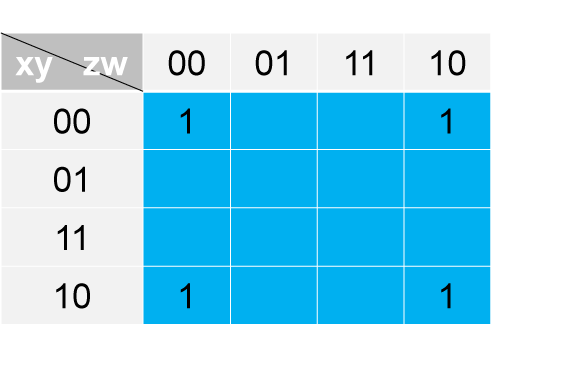
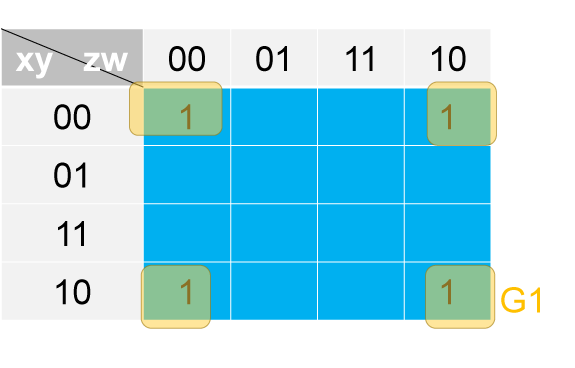
Reduce F = x’y’z’w’ + x’y’zw’ + xy’z’w’ + xy’zw’ to minimum number of literals
Step 1:
Placing 1 for respective box according to above structure.
Step 2:
Make groups of join-boxes containing values
Step 3:
For each group, select variable whose is not changed. And then create respective literal
For G1: y=0, w=0 → y’, w’
Step 4:
Create minterm for each group
For G1: y’w’
Step 5:
Create final function by adding for all minterms
F = y’w’
5. Example - 5
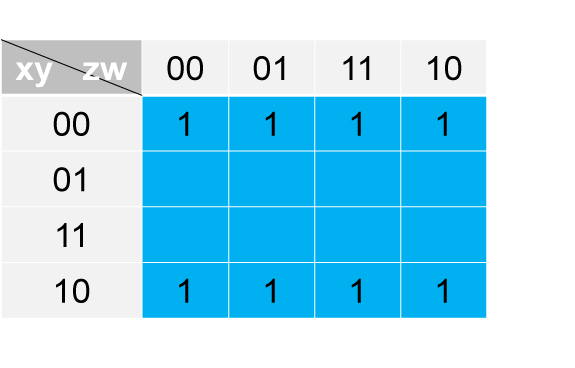
Reduce F = x’y’z’w’ + x’y’zw’ + xy’z’w’ + xy’zw’ + x’y’z’w + x’y’zw + xy’z’w + xy’zw to minimum number of literals
Step 1:
Placing 1 for respective box according to above structure.
Step 2:
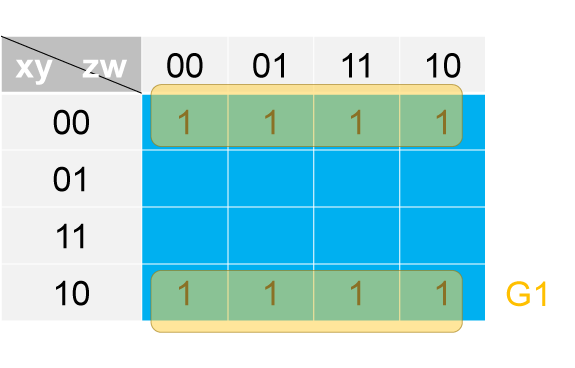
Make groups of join-boxes containing values
Step 3:
For each group, select variable whose is not changed. And then create respective literal
For G1: y=0 → y’
Step 4:
Create minterm for each group
For G1: y’
Step 5:
Create final function by adding for all minterms
F = y’
6. Example - 6
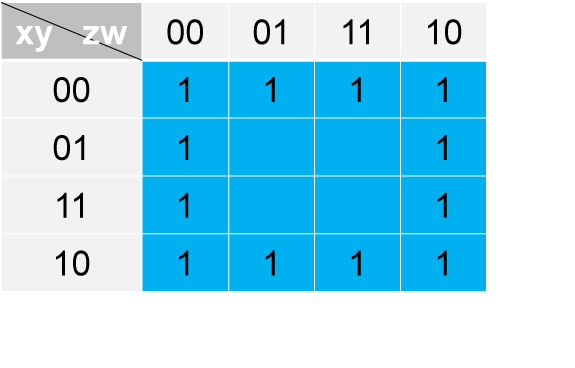
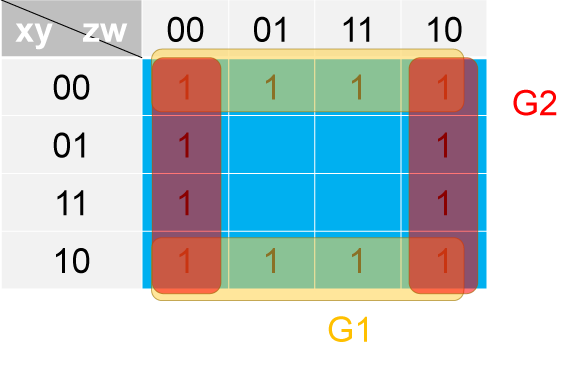
Reduce F = x’y’z’w’ + x’y’zw’ + xy’z’w’ + xy’zw’ + x’y’z’w + x’y’zw + xy’z’w + xy’zw + x’yz’w’ + xyz’w’ + x’yzw’ + xyzw’ to minimum number of literals
Step 1:
Placing 1 for respective box according to above structure.
Step 2:
Make groups of join-boxes containing values
Step 3:
For each group, select variable whose is not changed. And then create respective literal
For G1: y=0 → y’
For G2: w=0 → w’
Step 4:
Create minterm for each group
For G1: y’
For G2: w’
Step 5:
Create final function by adding for all minterms
F = y’ + w’
7. Example - 7
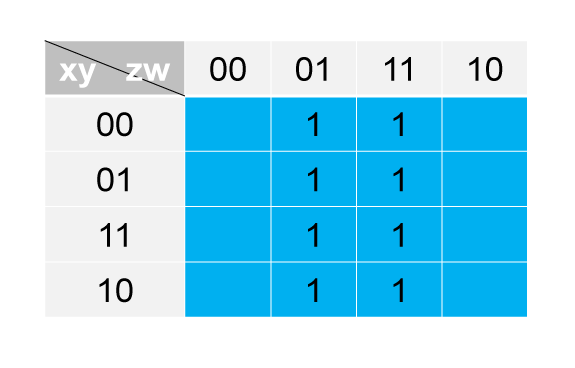
Reduce F = x’y’z’w + x’y’zw + x’yz’w + x’yzw + xyz’w + xyzw + xy’z’w + xy’zw to minimum number of literals
Step 1:
Placing 1 for respective box according to above structure.
Step 2:
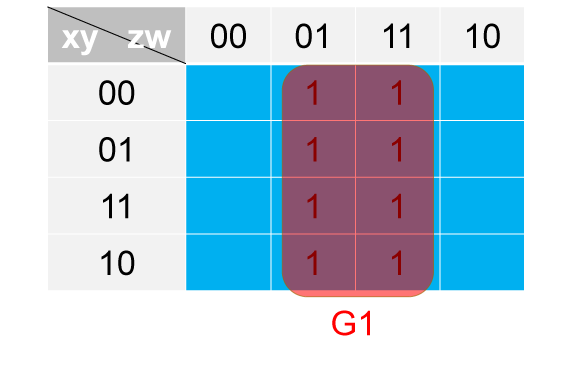
Make groups of join-boxes containing values
Step 3:
For each group, select variable whose is not changed. And then create respective literal
For G1: w=1 → w
Step 4:
Create minterm for each group
For G1: w
Step 5:
Create final function by adding for all minterms
F = w
8. Example - 8
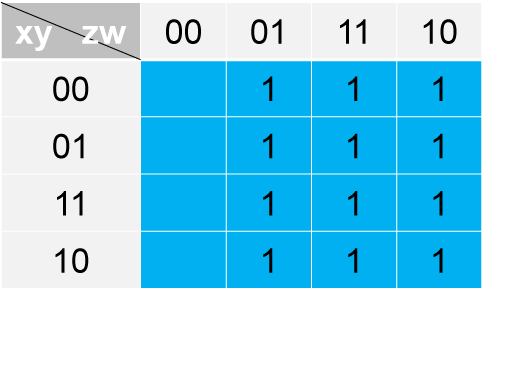
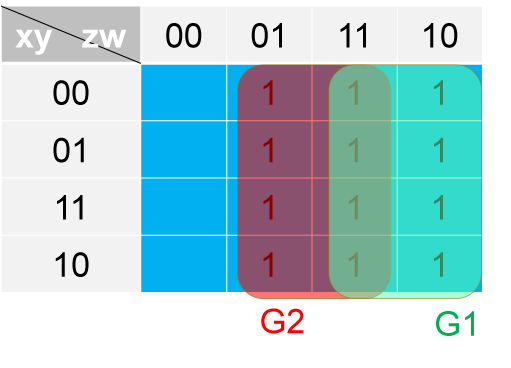
Reduce F = x’y’z’w + x’y’zw + x’yz’w + x’yzw + xyz’w + xyzw + xy’z’w + xy’zw + x’y’zw’ + x’yzw’ + xyzw’ + xy’zw’ to minimum number of literals
Step 1:
Placing 1 for respective box according to above structure.
Step 2:
Make groups of join-boxes containing values
Step 3:
For each group, select variable whose is not changed. And then create respective literal
For G1: z=1 → z
For G2: w=1 → w
Step 4:
Create minterm for each group
For G1: z
For G2: w
Step 5:
Create final function by adding for all minterms
F = z + w
9. Example - 9
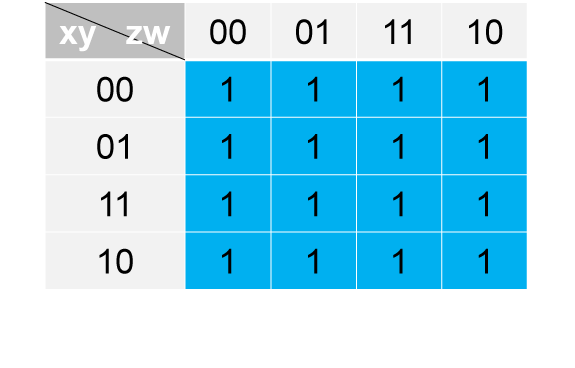
Reduce F = x’y’z’w + x’y’zw + x’yz’w + x’yzw + xyz’w + xyzw + xy’z’w + x’y’zw’ + x’yzw’ + xyzw’ + xy’z’w’ + x’y’z’w’ + x’yz’w’ + xyz’w’ + xy’zw’ + xy’zw to minimum number of literals
Step 1:
Placing 1 for respective box according to above structure.
Step 2:
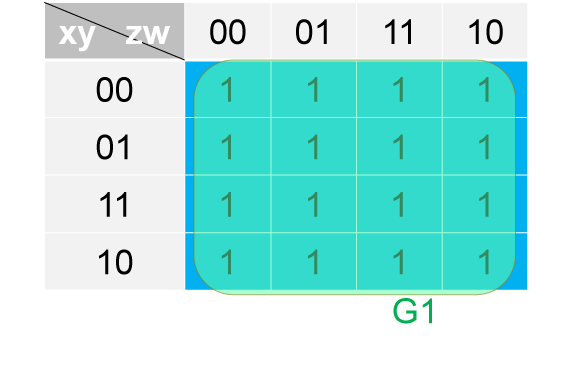
Make groups of join-boxes containing values
Step 3:
For each group, select variable whose is not changed. And then create respective literal
For G1: no such variable
Step 4:
Create minterm for each group
For G1: 1
Step 5:
Create final function by adding for all minterms
F = 1